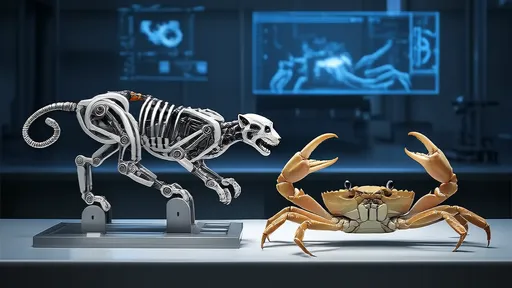
In the vast tapestry of nature, the study of animal locomotion has long captivated scientists and engineers alike, offering a wellspring of inspiration for innovation across numerous fields. From the blistering sprints of the cheetah to the intricate sideways scuttle of the crab, the diversity of movement in the animal kingdom presents a masterclass in efficiency, adaptation, and biomechanical genius. This exploration into the realm of biomimetics, specifically focusing on locomotion, reveals how nature's designs are being decoded and repurposed to solve complex human challenges in robotics, transportation, and material science.
The cheetah, renowned as the fastest land animal, embodies a pinnacle of evolutionary engineering for speed. Its ability to accelerate from 0 to 60 miles per hour in mere seconds is not merely a product of powerful muscles but a symphony of biomechanical adaptations. The cheetah's flexible spine acts like a spring, storing and releasing energy with each bound, while its elongated limbs and non-retractable claws provide exceptional grip and propulsion. This remarkable efficiency has become a blueprint for roboticists and automotive engineers. By studying the dynamics of its gallop, researchers have developed quadrupedal robots capable of stable, high-speed traversal across rough terrain, mimicking the big cat's gait to enhance mobility in search-and-rescue operations. Furthermore, the principles of its aerodynamic form and energy conservation are influencing the design of more efficient vehicles and athletic equipment, striving to minimize drag and maximize power transfer.
Transitioning from the open savannah to the complex littoral zone, the crab presents a fascinating contrast in locomotor strategy. Unlike the straightforward, high-velocity sprint of the cheetah, the crab employs a versatile and stable sideways walk, adeptly navigating the uneven and often treacherous surfaces of its coastal habitat. Its multiple legs operate in a highly coordinated, wave-like motion, providing a low center of gravity and exceptional stability against waves and predators. This unique form of ambulation is a goldmine for biomimetic applications, particularly in robotics designed for unstable environments. Engineers have created crab-inspired robots that can traverse muddy, rocky, or slippery surfaces where wheeled or even bipedal robots would fail. These robots, with their wide, stable bases and multi-jointed limbs, hold immense potential for underwater exploration, pipeline inspection, and disaster response in collapsed structures, demonstrating that speed is not always the paramount objective—sometimes, resilience and adaptability are king.
The field of animal movement mimicry extends far beyond these two iconic examples, weaving a complex web of interdisciplinary research. Scientists are delving into the undulating flight of birds and insects to revolutionize drone technology, creating agile micro-drones that can navigate tight urban canyons or dense forests. The efficient swimming motion of fish and cephalopods is inspiring a new generation of underwater propulsion systems for submarines and autonomous vehicles, offering quieter and more energy-efficient alternatives to traditional propellers. Even the intricate foot mechanics of geckos, which allow them to scale vertical glass surfaces, have spurred advances in adhesive technology. This cross-pollination of biology and engineering is not a one-way street; it often leads to a deeper appreciation and understanding of the biological systems themselves, creating a virtuous cycle of discovery and innovation.
However, the path from biological observation to practical application is fraught with challenges. Accurately replicating the nuanced mechanics, material properties, and sensory feedback loops of animals in synthetic systems requires immense computational power, advanced materials, and sophisticated control algorithms. A robotic cheetah leg is not made of muscle and bone but of actuators and carbon fiber, and translating the organic flexibility and instantaneous response of a biological system into a mechanical one is a monumental task. Similarly, programming the complex, adaptive gait of a crab—which can instantly adjust to a shifting sandbar or an incoming wave—into a robot's software requires breakthroughs in artificial intelligence and machine learning. Despite these hurdles, the progress is undeniable, with each successful prototype bringing us closer to harnessing the full potential of nature's designs.
As we peer into the future, the implications of locomotion biomimetics are profound. We are moving towards a world where robots can seamlessly operate in any environment humanity can—and cannot—easily access, from the deepest oceans to the surfaces of other planets, all by learning from the masters of movement that have evolved over millions of years. This is not about merely copying nature, but about understanding the fundamental principles that govern efficient motion and adapting them to serve our own purposes. The dance of the cheetah and the crawl of the crab are but two verses in a much larger epic written by evolution, and we are only just beginning to learn how to read its language.

By /Aug 25, 2025
By /Aug 25, 2025

By /Aug 25, 2025

By /Aug 25, 2025

By /Aug 25, 2025
By /Aug 25, 2025

By /Aug 25, 2025

By /Aug 25, 2025

By /Aug 25, 2025

By /Aug 25, 2025

By /Aug 25, 2025

By /Aug 25, 2025

By /Aug 25, 2025

By /Aug 25, 2025

By /Aug 25, 2025

By /Aug 25, 2025

By /Aug 25, 2025

By /Aug 25, 2025

By /Aug 25, 2025

By /Aug 25, 2025
