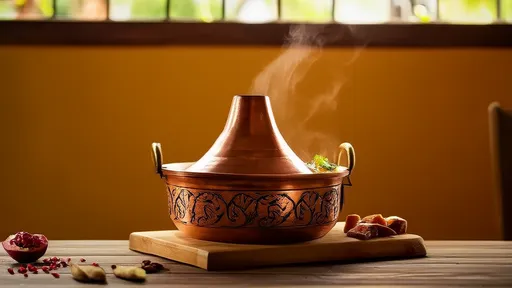
In the bustling souks of Marrakech and the quiet villages of the Atlas Mountains, one culinary icon stands as a testament to both tradition and ingenuity: the tajine. More than just a cooking vessel, the tajine is a masterpiece of culinary engineering, a slow-cooking system perfected over centuries. Its most defining feature, the distinctively shaped conical lid, is not merely an aesthetic choice but the very heart of a sophisticated steam-circulation mechanism that transforms simple ingredients into dishes of profound flavor and tenderness. This is not just pottery; it is a slow-food technology that has been simmering for generations.
The magic of the tajine lies in a beautiful and functional synergy between its two parts: the shallow, circular base and the tall, conical cover. Crafted traditionally from clay, sometimes glazed, sometimes not, the entire apparatus is designed for low, consistent heat, often from smoldering charcoal braziers. The base provides a wide, generous surface for meats and vegetables to be arranged, while the lid rises high above, creating a vast internal chamber. This chamber is the stage for the entire hydrological performance, a self-contained ecosystem where steam becomes the primary cooking medium.
The principle of convection is the invisible chef within the tajine. As the base heats up, moisture from the ingredients—onions, tomatoes, lemons, the meat itself—begins to evaporate. This steam, being lighter and hotter than the surrounding air, naturally rises. It travels up the smooth, sloping interior walls of the conical lid. Upon reaching the cooler apex of the cone, the steam condenses back into liquid form. This is the critical moment. These droplets of flavor-infused water then trickle down the sides of the lid, basting the ingredients below continuously and automatically.
This continuous cycle of evaporation and condensation creates a closed-loop system of remarkable efficiency. Very little moisture escapes, meaning no additional water or stock is typically needed. The ingredients essentially cook in their own juices, creating a sauce that is intensely concentrated and rich. The slow, gentle nature of the process is what makes tajine cooking so unique. Tough cuts of meat, like lamb shoulder or chicken thighs, break down collagen without ever seizing up or becoming tough. Vegetables soften and meld their flavors without disintegrating into mush. Every element retains its individual integrity while contributing to a harmonious whole.
This design is a brilliant answer to an environmental challenge. In North Africa, where water is a precious resource and fuel for fires can be scarce, efficiency is paramount. The tajine conserves both. It uses minimal liquid to create a succulent dish and requires only a small, steady source of heat rather than a roaring fire. This makes it an incredibly economical and sustainable method of cooking, perfectly adapted to its place of origin. The condensation process also means that nutrients and vitamins, which are often lost in boiling water or to high-heat cooking, are largely retained within the dish, making it a healthier preparation method as well.
Furthermore, the conical shape plays a crucial role in heat distribution. Unlike a flat lid that can create hot spots, the cone allows heat to circulate evenly around the food. The small opening at the very top of the cone, often crowned with a finial, acts as a miniature pressure valve. It allows for a minimal, controlled release of steam, preventing pressure from building up too much and ensuring the gentle cooking process is maintained. It is a perfectly balanced system of containment and release.
The result of this ancient engineering is a cuisine that is impossible to replicate exactly with modern pots and pans. The flavor profile of a true tajine is unmistakable. The sauce is never watery; it is unctuous and deeply layered. The meat is fall-apart tender yet never dry. The vegetables are imbued with the spices—saffron, ginger, cumin, cinnamon—without being overpowered by them. It is a dish that demands patience and rewards it with complexity. Each bite tells the story of the steam’s journey, up and down, again and again, concentrating flavor with every cycle.
In a world increasingly dominated by fast cooking and high-tech kitchen gadgets, the tajine remains a powerful reminder of the elegance of low-tech solutions. It is a testament to the deep understanding of physics and thermodynamics possessed by ancient craftspeople and cooks. They observed natural principles—convection, condensation, heat circulation—and baked them directly into clay. To lift the conical lid off a slowly simmering tajine and release the aromatic plume of steam is to witness a centuries-old miracle of culinary science, a perfect marriage of form and function that continues to nourish and delight.
By /Aug 20, 2025

By /Aug 20, 2025

By /Aug 20, 2025

By /Aug 20, 2025

By /Aug 20, 2025
By /Aug 20, 2025
By /Aug 20, 2025
By /Aug 20, 2025
By /Aug 20, 2025
By /Aug 20, 2025
By /Aug 20, 2025
By /Aug 20, 2025

By /Aug 20, 2025
By /Aug 20, 2025
By /Aug 20, 2025
By /Aug 20, 2025
By /Aug 20, 2025

By /Aug 20, 2025
By /Aug 20, 2025

By /Aug 20, 2025
